

IAR 80 – 81
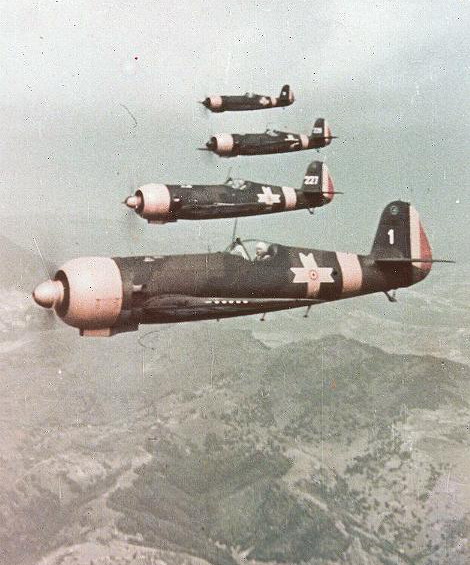
[tabs] [tab title=”Pe scurt”] IAR 80 – 81 The IAR 80 – 81 was a Romanian World War II low-wing, monoplane, all-metal monocoque fighter and ground-attack aircraft. About IAR 80 – 81 – Source Wikipedia Role: Fighter aircraft National origin: Romania Manufacturer: Industria Aeronautică Română (IAR) First flight: 12 April 1939 Introduction: February 1941 Status: Retired in 1949 and in 1952 (IAR- 80DC) Primary users: Royal Romanian Air Force Number built: 346 units produced up to 30 September 1944 (170 IAR 80; 176 IAR 81) Developed from: PZL P.24 Specifications (IAR 80) Data from IAR 80 – 81 General characteristics Crew: One, pilot Length: 8.9 m (29 ft 2 in) Wingspan: 10.52 m (34 ft 6 in) Height: 3.6 m (11 ft 10 in) Wing area: 16 m² (172.16 ft²) Empty weight: 1,780 kg (3,924 lb) Max. takeoff weight: 2250 kg (4,960 lb) Powerplant: 1 × IAR K.14-IV C32 air-cooled 14-cylinder double-row radial, 716 kW (960 hp) Performance Maximum speed: 495 km/h at 5,000 m (275 knots, 316 mph at 16,500 ft) Range: 940 km (507 nm, 580 mi) Service ceiling: 10,500 m (34,500 ft) Armament 4 × FN (Browning) 7.92 mm with 500 rounds each mounted in the inner portion of the wing Specifications (IAR 80A) Data from IAR 80 – 81 General characteristics Crew: One, pilot Length: 8.97 m (29 ft 5 in) Wingspan: 10.52 m (34 ft 6 in) Height: 3.525 m (11 ft 7 in) Wing area: 17 m² (183 ft²) Empty weight: 1617 kg (3,565 lb) Max. takeoff weight: 2,248 kg (4,957 lb) Powerplant: 1 × IAR K14-1000A air-cooled 14 cylinder double-row radial, 764 kW (1025 hp) Performance Maximum speed: 540 km/h (337.5 mph) Range: 1150 km (621 nm, 715 mi) Service ceiling: 10,500 m (34,500 ft) Wing loading: 132.35 kg/m² (27.1 lb/ft²) Armament 6 × FN (Browning) 7.92 mm with 500 rounds each mounted in the inner portion of the wing Specifications (IAR 80C) Data from IAR 80 – 81 General characteristics Crew: One, pilot Length: 8.97 m (29 ft 5 in) Wingspan: 11 m (36 ft 1 in) Height: 3.535 m (11 ft 7 in) Wing area: 17 m² (183 ft²) Empty weight: 2200 kg (4,850 lb) Max. takeoff weight: 2980 kg (6,570 lb) Powerplant: 1 × IAR K14-1000A air-cooled 14 cylinder double-row radial, 764 kW (1,025 hp) Performance Maximum speed: 560 km/h at 7,000 m (fully loaded with bomb attached) (300 knots, 347 mph at 22,965 ft) Range: 730 km on internal fuel only/1330 km with extra fuel tanks (394 nm, 454 mi/718 nm, 826 mi) Service ceiling: 10,000 m (32,800 ft) Wing loading: 132.35 kg/m² (27.1 lb/ft²) Armament 2 × 20 mm MG 151/20 cannon and 4 × 7.92 mm FN machine guns mounted in the inner portion of the wing; one 225 kg (500 lb) bomb under the fuselage Note One source states that the IAR.81Bs that were delivered as fighters were actually referred to as IAR.80C in service, reflecting the fact that they were used as fighters instead of bombers. It’s unclear if this was the case, and as the later 81C model definitely did not receive a „modified name” in the same fashion, it’s unlikely this was true. [/tab] [tab title=”Detailed information”] IAR 80 – 81 The IAR 80 – 81 was a Romanian World War II low-wing, monoplane, all-metal monocoque fighter and ground-attack aircraft. When it first flew, in 1939, it was comparable to contemporary designs such as the German Messerschmitt Bf 109E, the British Hawker Hurricane Mk.I, and the American Curtiss P-40B/Tomahawk Mk.I and superior to the Dutch Fokker D.XXI and Polish PZL P.24. However, production problems and lack of available armament delayed entry of the IAR 80 into service until 1941. It remained in front-line use until 1944. Development In order to ensure that the Royal Romanian Air Force or (ARR) could continue to be supplied with aircraft in time of war, the government subsidized the creation of three major aircraft manufacturers in the 1920s and 1930s. The first was Societatea pentru Exploatări Tehnice (SET) which was formed in Bucharest in 1923. Next came Industria Aeronautică Română (IAR) which set up shop in Braşov in 1925. Finally there was Intreprinderea de Construcţii Aeronautice Romaneşti (ICAR), which was founded in Bucharest in 1932. In 1930 the Romanian government issued specifications for a new fighter. Although the government did not expect bids from its own aircraft industry, IAR produced several prototype fighters in response to the tender. None of the other Romanian companies entered a bid, and as the industry was rife with corruption, the government nationalized IAR while the other two companies were left to their own devices. The fighter contract was eventually won by the Polish PZL P.11, which at the time was considered to be the best fighter in the world. The FARR purchased 50 of a modified version called the P.11b, all of which were delivered in 1934. A second contest was also fought between the newer IAR.24 and PZL P.24 designs, and once again the newer PZL design won a contract for another 50 aircraft. Although IAR’s own designs had not entered production, they nevertheless won the contracts to build many of the airframes under license, as well as providing the engines, licensed versions of the famous Gnome-Rhone 14K. Other licensed contracts included the Potez 25, the Morane-Saulnier 35, and the Fleet 10-G. As a result the company had enough money to fund a design shop even if its designs never saw production. Despite the constant race with PZL, an IAR design team led by Dr. Ion Grosu continued work on fighter designs. He was convinced that the low wing design pioneered on the IAR.24 represented a much better design than the PZL gull-wing design, which was often referred to as the „Polish wing”. Once again the team studied the new PZL fighter looking to incorporate its best features into a new plane, and the result was the IAR.80. Design Description: Low wing monoplane fighter with conventional control surface layout. Fuselage: The fuselage is circular in cross section, turning to egg shaped behind the cockpit where it incorporates a ridge-back. The general fuselage layout bears a certain
IAR 37 (38, 39)
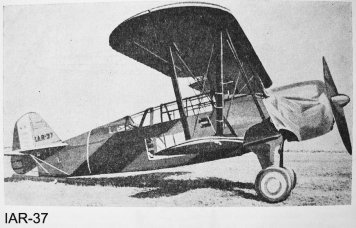
[tabs] [tab title=”Brief”] IAR 37 (38, 39) The IAR 37 was a 1930s Romanian reconnaissance or light bomber aircraft built by Industria Aeronautică Română. About IAR 37 (38, 39) – Source Wikipedia Role: Reconnaissance and light bomber National origin: Romania Manufacturer: Industria Aeronautică Română First flight: 1937 Introduction: 1938 Primary users: Royal Romanian Air Force Number built: 380 Specifications (IAR 39) Data from The Illustrated Encyclopedia of Aircraft (Part Work 1982-1985), 1985, Orbis Publishing, Page 2192 General characteristics Crew: Three Length: 9.60 m (31 ft 6 in) Wingspan: 13.10 m (42 ft 11¾ in) Height: 3.99 m (13 ft 1 in) Wing area: 40.30 m2 (433.80 ft2) Empty weight: 2177 kg (4799 lb) Gross weight: 3085 kg (6801 lb) Powerplant: 1 × IAR K.14-IV C32 radial piston, 716 kW (960 hp) Performance Maximum speed: 336 km/h (209 mph) Range: 1050 km (652 miles) Service ceiling: 8000 m (26,245 ft) Armament 3 x FN (Browning) 7.92 mm (0.31 in) machine gun 288kg (635lb) of bombs or 144 air-grenades [/tab] [tab title=”Detailed information”] IAR 37 (38, 39) The IAR 37 was a 1930s Romanian reconnaissance or light bomber aircraft built by Industria Aeronautică Română. Development The IAR 37 prototype was flown for the first time in 1937 to meet a requirement for a tactical bombing and reconnaissance aircraft. The IAR 37 was an unequal-span single bay biplane with a fixed tailwheel landing gear and powered by a licensed copy of the Gnome-Rhône Mistral Major radial engine called the IAR K14-II C32 with 870 HP. It had room for a crew of three under a continuous glazed cockpit, pilot at the front then observer and a gunner at the rear. It had dual controls and was fitted with a locally designed bombsight and a camera. The IAR 37 entered production in 1938, but production of the engine lagged, preventing the aircraft from being completed,and it was replaced on the production line by the IAR 38, powered by the reliable BMW 132 engine. As availability and reliability of the K.14 engine improved, the incomplete IAR 37s were fitted with IAR K.14-III C36 with 930 HP to allow their completion and production was switched to the improved IAR 39, which also used the IAR K.14-IV C32 with 960HP. Total production of all three types was 380, at both IAR and SET, continuing until October 1944 with the majority being IAR 39s.[1] Operational history The aircraft entered service with the Royal Romanian Air Force in 1938 and, by the end of the 1940, they equipped a large number of squadrons. When Romania supported the German offensive against the Soviet Union 15 of the 18 reconnaissance squadrons were equipped with IAR biplanes. The IAR 39 was used by most of the reconnaissance squadrons involved in the 1944 offensive against the Soviet Union. When the new post-war government was formed in 1947, a smaller number of IAR 39s were used by the new Romanian Air Force for training and liaison.[2] Variants IAR 37 Initial production. Powered by IAR K14-II C32 – 649 kW (870 hp) engine. 50 built.[3] IAR 38 Powered by 522 kW (700 hp) BMW 132A engine owing to unravailability of K14. Taller tail. 50 built.[3] IAR 39 Revised version of IAR 38 reverting to IAR K.14-III C36 – 690 kW (930 hp) engine. 95 built.[3] IAR 39A IAR K.14-IV C32 716 kW (960 hp) engine. 160 built.[3] [/tab] [tab title=”Gallery”] IAR 37 (38, 39) The IAR 37 was a 1930s Romanian reconnaissance or light bomber aircraft built by Industria Aeronautică Română. [nggallery id=20][/tab] [tab title=”Pilots”] IAR 37 (38, 39) The IAR 37 was a 1930s Romanian reconnaissance or light bomber aircraft built by Industria Aeronautică Română. [recent_posts count=”100″ cat=”45″][/tab] [/tabs]
IAR 23, IAR 24
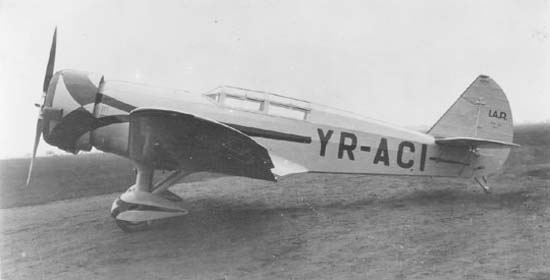
[tabs] [tab title=”Brief”] IAR 23, IAR 24 The IAR-23 and IAR-24 were low-wing monoplane light multipurpose aircraft with a conventional undercarriage, built by IAR of Romania. About IAR 23 – Source Wikipedia Role: Light multipurpose aircraft National origin: Romania Manufacturer: Industria Aeronautică Română First flight: 1934 Number built: 1 Specifications (IAR 23) Data from I Gudju, G Iacobescu, O Ionescu: Romanian Aeronautical Constructions 1905-1974 General characteristics Crew: Two pilots Capactity:4 passengers Length: 8.35 m (27 ft 5 in) Wingspan: 12.00 m (39 ft 4 in) Height: 2.70 m (8 ft 10 in) Wing area: 22.30 m2 (240.00 ft2) Empty weight: 980 kg (2156 lb) Gross weight: 1920 kg (4224 lb) Powerplant: 1 × Hispano-Suiza 9Qa radial piston, 253 kW (340 hp) Performance Maximum speed: 245 km/h (153 mph) Cruise speed: 215 km/h (134 mph) Range: 2300 km (1437 miles) Service ceiling: 4100 m (13,670 ft) Aircraft of comparable role, configuration and era LWD Szpak, Aero A.200, PZL.26, Messerschmitt Bf 108 [/tab] [tab title=”Detailed information”] IAR 23, IAR 24 The IAR-23 and IAR-24 were low-wing monoplane light multipurpose aircraft with a conventional undercarriage, built by IAR of Romania. Development The IAR-23 was created in 1934 by the Romanian company Industria Aeronautică Română (IAR) as an attempt to design a next-generation fighter for the Royal Romanian Air Force, but because its low power, it was classified only as a civilian touring aircraft. However, it contained many advanced features for its time, including uniquely designed wings. After the installation of additional fuel tanks, it turned into a long-haul touring plane, with a maximum range of 2300 km. An improved version, the IAR-24, was created in 1935. It used the same airframe, but had a modernized cockpit and a slightly more powerful engine that yielded a higher cruising speed. Operators Only one IAR-23 existed, and its tail number was YR-IAR. It was delivered to Major G. Bănciulescu in September 1934, who later undertook several long-haul flights with the aircraft through Europe (from Bucharest to Warsaw, Prague and Vienna). The next year, the IAR-23 was flown to Tel-Aviv and back. The IAR-24 was manufactured in a single example as well, and it had tail number YR-ACI. The ultimate fate of both aircraft is unknown. [/tab] [tab title=”Gallery”] IAR 23, IAR 24 The IAR-23 and IAR-24 were low-wing monoplane light multipurpose aircraft with a conventional undercarriage, built by IAR of Romania. [nggallery id=18][/tab] [tab title=”Pilots”] IAR 23, IAR 24 The IAR-23 and IAR-24 were low-wing monoplane light multipurpose aircraft with a conventional undercarriage, built by IAR of Romania. [recent_posts count=”100″ cat=”43″][/tab] [/tabs]
de Havilland DH.71 Tiger Moth
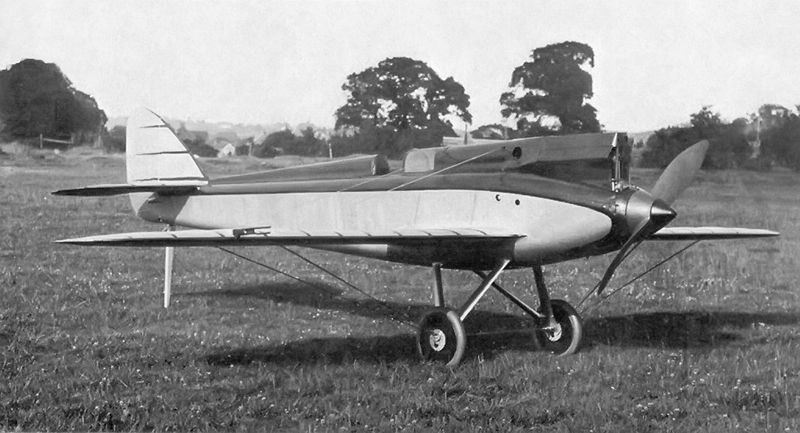
[tabs] [tab title=”Brief”] de Havilland DH.71 Tiger Moth The de Havilland DH.71 Tiger Moth was a single-seat monoplane, designed to research high-speed flight and test replacement engines for the Cirrus engine. About ‘de Havilland DH.71 Tiger Moth’ – Source Wikipedia Role: High-speed research and racing monoplane Manufacturer: De Havilland Aircraft Company First flight: June 24, 1927 Introduction: 1927 Number built: 2 Specifications (de Havilland DH.71 Tiger Moth) General characteristics Crew: One Length: 18 ft 7 in (5.66 m) Wingspan: 22/19 ft 6 in (6.86/5.79 m) Height: 7 ft 0 in (2.13 m) Wing area: 76.5 ft2 (7.11 m2) Empty weight: 618 lb (280 kg) Gross weight: : 905 lb (411 kg) Powerplant: 1 × ADC Cirrus II inline piston/de Havilland Gipsy prototype., 85/135 hp (63 kW) each [/tab] [tab title=”Detailed information”] de Havilland DH.71 Tiger Moth The de Havilland DH.71 Tiger Moth was a single-seat monoplane, designed to research high-speed flight and test replacement engines for the Cirrus engine. Development The de Havilland DH.71 Tiger Moth was a single-seat monoplane, designed to research high-speed flight and test replacement engines for the Cirrus engine. The plane was designed around its test pilot, Hubert Broad, to make it as streamlined as possible: this resulted in the fuselage sides being sloped outwards in order to accommodate his shoulders. The first aircraft built (G-EBQU) was initially fitted with an 85 hp Cirrus engine to check its handling characteristics. This was then replaced with Major Halford’s prototype engine, by then named the Gipsy. The second example, G-EBRV, was fitted with a Cirrus engine. Both aircraft were entered for the 1927 King’s Cup race but ‘QU was withdrawn in order to be tuned for record-breaking purposes. Broad flew ‘RV in the race but retired. In August 1927, Broad flew a 62-mile (100 km) closed-circuit record for Class III Light Aircraft of 186.47 mph (300.09 km/h). Five days later he flew to 19,191 ft (5,849 m) without oxygen in an attempt to break the altitude record for its category. For these record attempts the aircraft was fitted with a new set of mainplanes with a reduced span of 5.79 metres. In 1930, the first DH.71 crashed when the engine cut out while practising for a race in Australia, killing pilot David Smith. The second airframe was for a time displayed outside de Havilland’s Hatfield factory, eventually being destroyed there in a Luftwaffe air raid in October 1940. [/tab] [tab title=”Gallery”] de Havilland DH.71 Tiger Moth The de Havilland DH.71 Tiger Moth was a single-seat monoplane, designed to research high-speed flight and test replacement engines for the Cirrus engine. [nggallery id=14][/tab] [tab title=”Pilots”] de Havilland DH.71 Tiger Moth The de Havilland DH.71 Tiger Moth was a single-seat monoplane, designed to research high-speed flight and test replacement engines for the Cirrus engine. [recent_posts count=”100″ cat=”39″][/tab] [/tabs]
Fleet Model 1
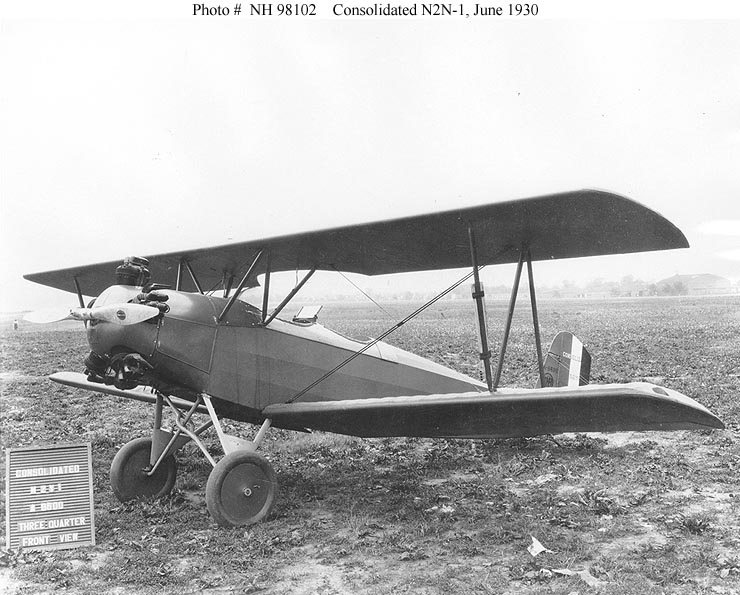
[tabs] [tab title=”Brief”] Fleet Model 1 The Fleet Model 1 (originally the Consolidated Model 14 Husky Junior) and its derivatives were a family of two-seat trainer and sports plane produced in the United States and Canada in the 1920s and 30s. About Fleet Model 1 – Source Wikipedia Role: Recreational and training aircraft Manufacturer: Consolidated, Fleet First flight: 9 November 1928 Designer: Reuben Fleet Specifications (Fleet Model 2) General characteristics Crew: One pilot Capacity: One passenger Length: 21 ft 8 in (6.61 m) Wingspan: 28 ft 0 in (8.54 m) Height: 7 ft 9 in (2.36 m) Wing area: 194 ft2 (18.0 m2) Powerplant: 1 × Kinner K-5, 100 hp (75 kW) Performance Maximum speed: 105 mph (169 km/h) Range: 350 miles (560 km) Service ceiling: 12,200 ft (3,700 m) [/tab] [tab title=”Detailed information”] Fleet Model 1 The Fleet Model 1 (originally the Consolidated Model 14 Husky Junior) and its derivatives were a family of two-seat trainer and sports plane produced in the United States and Canada in the 1920s and 30s. Development The Fleet Model 1 (originally the Consolidated Model 14 Husky Junior) and its derivatives were a family of two-seat trainer and sports plane produced in the United States and Canada in the 1920s and 30s. They all shared the same basic design and varied mainly in their powerplants. They were all orthodox biplanes with staggered, single-bay wings of equal span and fixed tailskid undercarriage. Accommodation was provided for two in tandem, originally sharing a single open cockpit, but in most examples in separate open cockpits. The fuselage was made of welded steel tube with triangular-layout Warren truss construction pattern side structures typical of the time, and the wings had a wooden spar with duralumin ribs, the entire aircraft being fabric-covered. Despite a superficial resemblance to Consolidated’s highly successful Trusty and Husky designs (hence the „Husky Junior” nickname), the Model 14 was an all-new design. Originally created as a means for Consolidated to enter the civil market, the company abandoned this ambition shortly before the completion of the first prototype. The manufacturing rights were purchased by designer and Consolidated company president Reuben Fleet to put into production himself under a new enterprise, Fleet Aircraft. It was an immediate success, and in the first year of production alone, over 300 machines were sold. Consolidated quickly responded by buying Fleet Aircraft and retaining it as a subsidiary while opening a second production line at Fort Erie, Ontario, Canada. Canadian manufacturing was a great success, with some 600 examples built for the Royal Canadian Air Force as the Fleet Fawn (Model 7) and Fleet Finch (Model 16). A small number of US-built machines were purchased by the US military, including a batch evaluated by the United States Army Air Corps as the PT-16 but not bought in quantity, and six specialised N2Y trainers for the United States Navy equipped with hooks to catch the trapeze on aircraft-carrying airships and train F9C Sparrowhawk pilots. US manufacturing rights were eventually sold to Brewster, which intended to produce the Brewster B-1 based on the Canadian Model 16F. Variants Fleet Model 2 On display in the Cradle of Aviation Museum Fleet Model 7 Consolidated Model 14 Husky Junior: prototypes (ca. 5 built) Fleet Model 1: initial production version with Warner Scarab engine (ca. 90 built) Fleet Model 2: initial production version with Kinner K-5 engine (203 built) – PT-6 – USAAC designation for Model 2 (16 built) – N2Y-1 – USN version with trapeze hook for airship docking training (5 built) Fleet Model 3: version with Wright J-6 engine (1 converted from Model 2) Fleet Model 4: version with Curtiss Challenger engine (1 built) Fleet Model 5: version with Brownback C-400 engine (1 built) Fleet Model 6: improved version for USN as XN2Y-2, later further modified as an autogiro by Pennsylvania Aircraft with the upper wing replaced by a rotor, it was redesignated XOZ-1 (1 built) Fleet Model 7: version with Kinner B-5 engine (48 built, plus several converted from Model 2 by Fleet in Canada) – Fleet Model 7A – Fleet Model 7B – Canadian production version – Fleet Model 7C – Canadian production version with Armstrong Siddeley Civet engine – Fleet Model 7G – Canadian production version with de Havilland Gipsy III engine – XPT-6 – One Model 7 acquired by the US Army Air Corps for service tests. Version with 100-hp Kinner R-370-1 (Kinner K5) engine – YPT-6 – ten aircraft similar to the XPT-6, used by the US Army Air Corps for service tests and evaluation – YPT-6A – modified version of the Model 7 fitted with an enlarged cockpit. Used by the US Army Air Corps for service tests and evaluation Fleet Model 8: three-seat version similar to Model 7 (7 built) Fleet Model 9: refined version of Model 8 (12 built) Fleet Model 10: refined version of Model 7 for export to Europe – Fleet Model 10A – version with 100 hp Kinner engine – Fleet Model 10B – version with 125 hp Kinner engine – Fleet Model 10D – version with 160 hp Kinner engine – Fleet Model 10-32D – generally similar to the Model 10D, but with an increased 4-ft 0-in (1.22-m) wingspan – Fleet Model 10E – version with 125 hp Warner engine – Fleet Model 10F – version with 145 hp Warnerengine – Fleet Model 10G – version with de Havilland Gypsy Major engine for governments of Portugal and Romania (ca. 70 built) – Fleet Model 10H – version with Menasco C-4S engine Fleet Model 11: version with Kinner R-5 engine; some exported to China and Mexico Fleet Model 14: Model 2 modified for participation in Guggenheim Safe Aircraft Competition but disqualified. ca. 300 licence-built in Romania. Fleet Model 16: Fleet Finch – strengthened Canadian production version with sliding canopy, powered by a 130 hp de Havilland Gipsy Major engine (ca. 600 built) – Fleet Model 16B – Fleet Finch Mk II – Strengthened Canadian production version, powered by a Kinner B5 engine – Fleet Model 16D – similar to the Model 16B, but fitted
Fiesler Fi 156 (Storch)
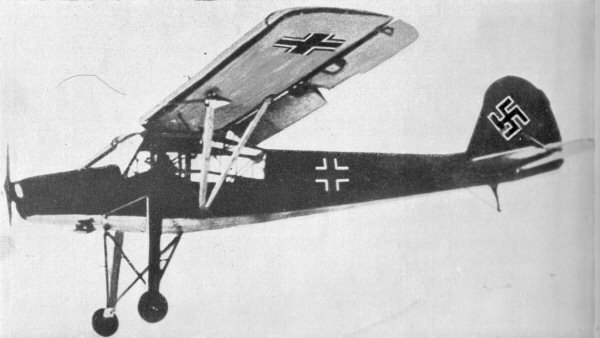
[tabs] [tab title=”Brief”] Fiesler Fi 156 (Stork) The Fieseler Fi 156 Storch (English: Stork) was a small German liaison aircraft built by Fieseler before and during World War II. About Fiesler Fi 156 (Stork) – Source Wikipedia Role: Reconnaissance and communications Manufacturer: Fieseler, Morane-Saulnier Designers: Gerhard Fieseler, Reinhold Mewes, Erich Bachem First flight: 24 May 1936 Introduction: 1937 Status: Retired 1945 (Germany), 1970 (France) Primary users: Luftwaffe, Aviation Légère de l’Armée de Terre, Armée de l’Air Number built: Over 2,900 Specifications (Fi 156) General characteristics Crew: Two Length: 9.9 m (32 ft 6 in) Wingspan: 14.3 m (46 ft 9 in) Height: 3.1 m (10 ft 0 in) Wing area: 26 m² (280 ft²) Empty weight: 860 kg (1,900 lb) Loaded weight: 1,260 kg (2,780 lb) Powerplant: 1 × Argus As 10 air-cooled inverted V8 engine, 180 kW (240 hp) Performance Maximum speed: 175 km/h (109 mph) at 300 m (1,000 ft) Range: 380 km (210 nmi, 240 mi) Service ceiling: 4,600 m (15,090 ft) Rate of climb: 4.8 m/s (945 ft/min) Wing loading: 48.5 kg/m² (9.9 lb/ft²) Power/mass: 143 W/kg (0.087 hp/lb) Armament Guns:MG 15 machine gun [/tab] [tab title=”Detailed information”] Fiesler Fi 156 (Stork) The Fieseler Fi 156 Storch (English: Stork) was a small German liaison aircraft built by Fieseler before and during World War II. The Fieseler Fi 156 Storch (English: Stork) was a small German liaison aircraft built by Fieseler before and during World War II. Production continued in other countries into the 1950s for the private market. It remains famous to this day for its excellent STOL performance; French-built later variants often appear at air shows. Conception and production Design and development In 1935, the RLM (Reichsluftfahrtministerium, Reich Aviation Ministry) invited tenders from several companies for a new Luftwaffe aircraft suitable for liaison, army co-operation (today called Forward Air Control), and medical evacuation. This resulted in the Messerschmitt Bf 163 and Siebel Si 201 competing against the Fieseler firm’s tender. Conceived by chief designer Reinhold Mewes and technical director Erich Bachem, Fieseler’s design had a far better STOL (Short Take Off and Landing) performance. A fixed slat ran along the entire length of the leading edge of the long wings, while a hinged and slotted flap ran along the entire length of trailing edge. This was inspired by earlier 1930s Junkers „double-wing” aircraft wing control surface designs, including the ailerons. A design feature rare for land-based aircraft, enabled the wings on the Storch to be folded back along the fuselage in a manner similar to the wings of the US Navy’s F4F Wildcat fighter. This allowed the aircraft to be carried on a trailer or even towed slowly behind a vehicle. The primary hinge for the folding wing was located in the wing root, where the rear wing spar met the cabin. The long legs of the main landing gear contained oil-and-spring shock absorbers that had a travel of 450 mm (18 inches), allowing the plane to land on comparatively rough and uneven surfaces. In flight the landing gear legs hung down, giving the aircraft the appearance of a long-legged, big-winged bird, hence its nickname, Storch. With its very low landing speed the Storch often appeared to land vertically, or even backwards, in strong winds from directly ahead. German production About 2,900 Fi 156s, mostly Cs, were produced from 1937 to 1945 at the Fieseler Factory in Kassel. In 1942 production started in the Morane-Saulnier factory at Puteaux in France. Due to the demand for the Bf 109 and the Fw 190, Storch production was shifted to the Leichtbau Budweis in Budweis in 1943. Czech production In 1944 production was moved from the Leichtbau Budweis to the Mráz factory in Chocen which produced 138 examples of Fi 156, locally designated as K-65 Čáp. Production ended in 1949. French production Immediately after the liberation of France in 1944, the production of Storch at the Morane-Saulnier factory was continued at the request of the Armée de l’Air and designated MS 500 for the batch of aircraft produced with the remaining stock of Argus engines. Further modification and use of different engines (inline and radial) are known under different type. The use of the plane in Indochina highlighted the weakness of the wood in the construction of the airframe; it was then decided to build the wings in metal. Among the modifications, the defensive weapon aiming through the back window was dropped, although some aircraft have then been modified on the field to take a machine gun MAC 34T firing through one of the side windows. 141 aircraft were built before the end of World War II and a total of 925 aircraft were built before the end of the production of all type of Criquet by Morane-Saulnier in 1965. Romanian production Licence production was also started in Romania in 1943 at the ICAR factory in Bucharest. Only 10 were built by the time Romania switched sides, with a further 70 aircraft being built by the Romanians before production ended in 1946.[2] Modern development Because of its superb STOL characteristics, there have been many attempts to recreate or copy the Storch, namely in the form of various homebuilt aircraft such as the Pazmany Stork and Roger Mann’s Ragwing Stork. Another is the Slepcev Storch designed by Nestor Slepcev. It is a ¾ scale reproduction of the original with some simplifications. The use of modern materials provides better STOL performance than the original with a take-off run of 30 m and landing-roll of 50 m with no headwind.[3] Operational history During WWII The Storch was deployed in all European and North African theaters of World War II. But it is probably most famous for its role in Operation Eiche, the rescue of deposed Italian dictator Benito Mussolini from a boulder-strewn mountain-top near the Gran Sasso. Even though the mountain was surrounded by Italian troops, German commando Otto Skorzeny and 90 paratroopers parachuted onto the peak and quickly captured it. But the problem remained of how to get back off. A Focke-Achgelis Fa 223 helicopter was sent, but it broke down en route.
Caudron C.640 Typhon
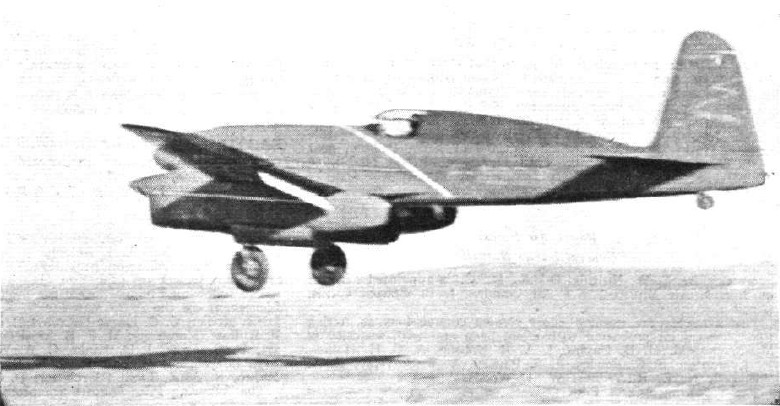
[tabs] [tab title=”Brief”] Caudron C.640 Typhon The Caudron C.640 Typhon was a 1930s French high-speed single-seat monoplane utility aircraft built by Caudron-Renault About Caudron C.640 Typhon – Source Wikipedia Role: High-Speed Mailplane Manufacturer: Caudron-Renault Designers: Georges Otfinovsky, Marcel Riffard First flight: 1935 Introduction: 1935 Number built: 10 Specifications (C.640) General characteristics Crew: Two Length: 35 ft 11 in (10.95 m) Wingspan: 47 ft 6¾ in (11.50 m) Height: 9 ft 10 in (3.00 m) Wing area:301.40 ft² (28.00 m²) Empty weight: 3,594 lb (1630 kg) Max. takeoff weight: 7,496 lb (3400 kg) Powerplant: 2 × Renault 6Q inline piston engine, 220 hp (164 kw) each Performance Maximum speed: 249 mph (400 km/h) Range: 2,315 miles (3725 km) Service ceiling: 22,965 ft (7000 m) [/tab] [tab title=”Detailed information”] Caudron C.640 Typhon The Caudron C.640 Typhon was a 1930s French high-speed single-seat monoplane utility aircraft built by Caudron-Renault History Similar in concept to the de Havilland DH.88 Comet the Typhon (en: Typhoon) was designed by Georges Otfinovsky and Marcel Riffard for use on long-range postal routes. The first aircraft first flew in March 1935. The aircraft was a twin-engined low-wing cantilever monoplane of wooden construction. Seven C.640s were built. The Typhon established 5000km speed records. It was not a success in operation as its flexible wings experienced buffeting and vibration problems. Variants C.640 Typhon: – production model with Renault 6Q engines, 7 built. C.641 Typhon: – record breaking version with raised canopy and increased fuel capacity, 2 built. C.670 Typhon – prototype high-speed bomber version with a crew of three, similar to the C.640 but with increased dimensions and weights, one built. [/tab] [tab title=”Gallery”] Caudron C.640 Typhon The Caudron C.640 Typhon was a 1930s French high-speed single-seat monoplane utility aircraft built by Caudron-Renault [nggallery id=10][/tab] [tab title=”Pilots”] Caudron C.640 Typhon The Caudron C.640 Typhon was a 1930s French high-speed single-seat monoplane utility aircraft built by Caudron-Renault [recent_posts count=”100″ cat=”35″][/tab] [/tabs]
Bücker Bü 180 Student
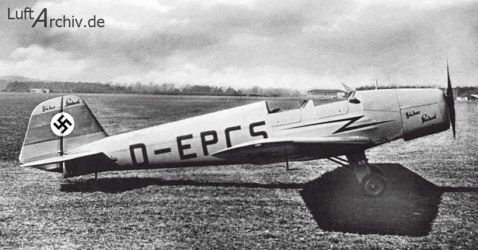
[tabs] [tab title=”Brief”] Bücker Bü 180 Student The Bücker Bü 180 Student was a 1930s German two-seat sporting/training aircraft built by Bücker Flugzeugbau. About Bücker Bü 180 Student – Source Wikipedia Role: Two-seat sport/training monoplane Manufacturer: Bücker Flugzeugbau First flight: 1937 Specifications (Bü 180) Data from Aircraft of the Third Reich[1], The Encyclopedia of World Aircraft General characteristics Crew: Two Length: 7.1 m (23 ft 4 in) Wingspan: 11.5 m (37 ft 9 in) Height: 1.85 m (6 ft 1 in) Wing area: 15 m2 (160 sq ft) Empty weight: 295 kg (650 lb) Gross weight: 540 kg (1,190 lb) Powerplant: 1 × Walter Mikron II inverted 4-cyl. air-cooled in-line piston engine, 45 kW (60 hp) Propellers: 2-bladed fixed pitch propeller Performance Maximum speed: 175 km/h (109 mph; 94 kn) at sea level Cruise speed: 160 km/h (99 mph; 86 kn) Range: 650 km (404 mi; 351 nmi) Service ceiling: 4,500 m (14,764 ft) Time to altitude: 1,000 m (3,281 ft) in 8 minutes 54 seconds [/tab] [tab title=”Detailed information”] Bücker Bü 180 Student The Bücker Bü 180 Student was a 1930s German two-seat sporting/training aircraft built by Bücker Flugzeugbau. Design and development Following on from the success of the Bü 133 Jungmeister the company designed a trainer aircraft, the Bü 180 (later named Student) which was a low-wing cantilever monoplane. The wing was of wooden construction with a mixture of plywood and fabric covering. The fuselage was a steel tube frame forward and a wooden monocoque aft with a fabric covering. The Student had a fixed tailskid landing gear and was powered by a Walter Mikron II inline engine. The prototype first flew in 1937 and a small number were built for civilian use. Variants Bü 180A Production variant with a 50hp Zündapp Z9-092 engine. Bü 180B Production variant with a 60hp Walter Mikron II engine. Bü 180C Proposed variant with a 80hp Bücker Bü M700 engine. [/tab] [tab title=”Gallery”] Bücker Bü 180 Student The Bücker Bü 180 Student was a 1930s German two-seat sporting/training aircraft built by Bücker Flugzeugbau. [nggallery id=9][/tab] [tab title=”Pilots”] Bücker Bü 180 Student The Bücker Bü 180 Student was a 1930s German two-seat sporting/training aircraft built by Bücker Flugzeugbau. [recent_posts count=”100″ cat=”34″] [/tab] [/tabs]
Bücker Bü 131 (Jungmann)
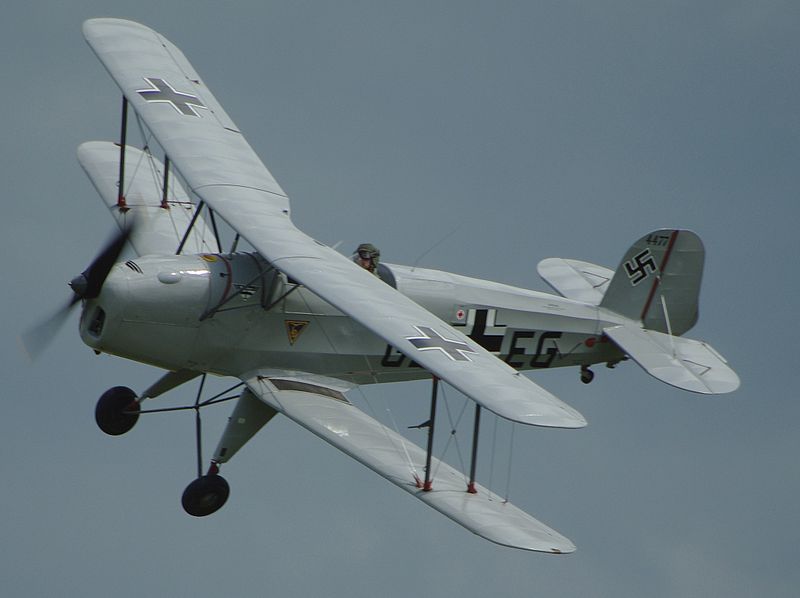
[tabs] [tab title=”Brief”] Bücker Bü 131 (Jungmann) The German Bücker Bü 131 „Jungmann” (Young man) was a 1930s basic training aircraft which was used by the Luftwaffe during World War II. About Bücker Bü 131 (Jungmann) – Source Wikipedia Role: Basic trainer Manufacturer: Bücker Flugzeugbau Designer: Carl Bücker First flight: 27 April 1934 Introduction: 1935 (Luftwaffe) Status: Retired in 1968 (Spanish Air Force) Primary users: Luftwaffe, Spanish Air Force, Imperial Japanese Army Air Service, Variants: Bü 133 Jungmeister Specifications (Bü 131B) Data from Jane’s Fighting Aircraft of World War II General characteristics Crew: Two (student and instructor) Length: 6.62 m (21 ft 8 in) Wingspan: 7.40 m (24 ft 3 in) Height: 2.35 m (7 ft 6 in) Wing area: 13.5 m² (145 ft²) Empty weight: 380 kg (840 lb) Loaded weight: 670 kg (1,500 lb) Powerplant: 1 × Hirth HM 504 four-cylinder inverted inline engine, 70 kW (100 hp) Performance Maximum speed: 183 km/h (99 kn, 115 mph) Cruise speed: 170 km/h (92 kn, 110 mph) Range: 628 km (339 nm, 390 mi) Service ceiling: 4,050 m (13,300 ft) Rate of climb: 2.8 m/s (6,600 ft) Wing loading: 46.3 kg/m² (9.49 lb/ft²) Power/mass: 100 W/kg (0.064 hp/lb) [/tab] [tab title=”Detailed information”] Bücker Bü 131 (Jungmann) The German Bücker Bü 131 „Jungmann” (Young man) was a 1930s basic training aircraft which was used by the Luftwaffe during World War II. Development After serving in the Kaiserliche Marine in World War I, Carl Bücker moved to Sweden where he became managing director of Svenska Aero AB (Not to be confused with Svenska Aeroplan AB, SAAB). He later returned to Germany with Anders J Andersson, a young designer from SAAB. Bücker Flugzeugbau GmbH was founded in Berlin-Johannistahl, in 1932, with the first aircraft to see production being the Bü 131 Jungmann. Bücker Flugzeugbau’s first production type, the Bü 131A was the last biplane built in Germany. It had two open cockpits in tandem and fixed landing gear. The fuselage was steel tube, covered in fabric and metal, the wings wood and fabric. It first flew on the 80 hp (60 kW) Hirth HM60R. In 1936, it was followed by the Bü 131B, with a 105 hp (78 kW) Hirth 504A-2. Most wartime production for the Luftwaffe was by Aero in Prague. Operational history Sturdy and agile, the Bü 131A was first delivered to the Deutscher Luftsportverband (DLV). The Bü 131B was selected as the primary basic trainer for the German Luftwaffe, and it served with „virtually all” the Luftwaffe’s primary flying schools during the war, as well as with night harassment units such as Nachtschlacht Gruppen (NSGr) 2, 11, and 12. Yugoslavia was the main prewar export customer; „as many as 400 may have found their way” there. She was joined by Bulgaria with 15 and Rumania with 40. Production licenses were granted to Switzerland (using 94, 88 built under licence to Dornier), Spain (building about 530), Hungary (which operated 315), Czechoslovakia (10, as the Tatra T 131, before war began), and Japan, the last of which built 1,037 for Army with Hatsukaze power as the Kokusai Ki-86 and 339 for the Navy Air Services as the Kyushu K9W. In Spain, production continued at CASA until the early 1960s. The Jungmann was retained as the Spanish Air Force’s primary basic trainer until 1968. About 200 Jungmanns survive to this day, many having been fitted with modern engines. In 1994, the Bü 131 was restored to production briefly using CASA jigs by Bücker Prado in Spain, with 21 aircraft constructed as the BP 131, while SSH Janusz Karasiewicz in Poland also started production of a version of the Jungmann based on Czech plans in 1994. Variants Bü 131A Two-seat primary trainer biplane. Initial production version. Bü 131B Improved version, powered by the more powerful Hirth HM 504A-2 piston engine. Bü 131C Experimental version, fitted with 67 kW (90 hp) Cirrus Minor piston engine. One built. Nippon Kokusai Ki-86A apanese production version for the Imperial Japanese Army Air Service. Powered by a Hitachi Ha-47 Nippon Kokusai Army Type 4 Primary Trainer The long designation for the Ki-86A Nippon Kokusai Ki-86B An all-wooden airframe version to relieve scarce supplies of strategic materials. Kyushu K9W1 Momiji Japanese production version for the Imperial Japanese Navy. Poewered by the Hitachi GK4A Hatsukaze 11 Kyushu Navy Type 2 Trainer Model 11 The long designation for the Kyushu K9W1 Tatra T.131 Czechoslovakia, pre-war licence production in Tatra Koprivnice. Aero C-4 Mass-produced in Aero factory in occupied Czechoslovakia during wartime under original Bücker Bü 131B designation, used postwar with original Hirth engine. Aero C-104 Czechoslovakia, postwar development with a Walter Minor 4-III engine, 260 aircraft built. CASA 1.131 Spanish license-built versions BP 131 Modern license-built version SSH T-131P Pre-production modern Polish version, powered by 78 kW (105 hp) Walter Minor 4-III engine. Four built from 1994. SSH T-131PA Main Polish production version, with 103 kW (138 hp) LOM M332AK engine. First flew 1995. [/tab] [tab title=”Gallery”] Bücker Bü 131 (Jungmann) The German Bücker Bü 131 „Jungmann” (Young man) was a 1930s basic training aircraft which was used by the Luftwaffe during World War II. [nggallery id=8][/tab] [tab title=”Pilots”] Bücker Bü 131 (Jungmann) The German Bücker Bü 131 „Jungmann” (Young man) was a 1930s basic training aircraft which was used by the Luftwaffe during World War II. [recent_posts count=”100″ cat=”33″][/tab] [/tabs]
Consolidated B-24 Liberator
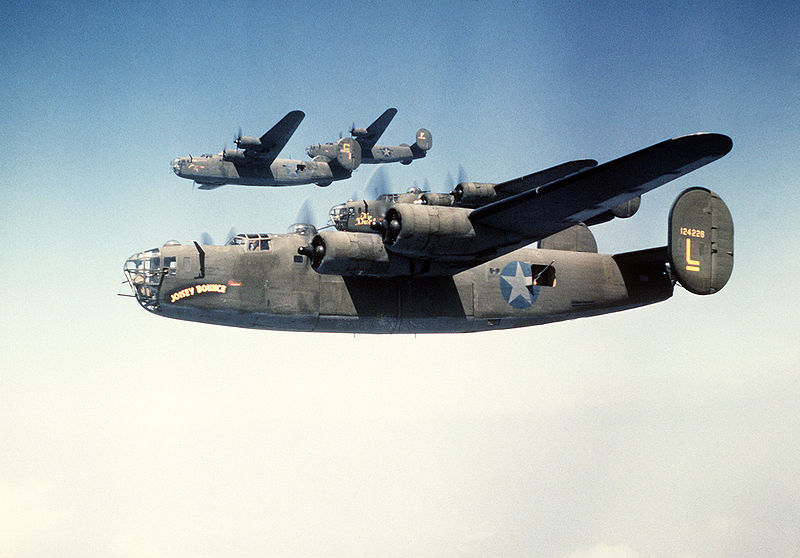
[tabs] [tab title=”Brief”] Consolidated B-24 Liberator The Consolidated B-24 Liberator was an American heavy bomber, designed by Consolidated Aircraft of San Diego, California About Consolidated B-24 Liberator – Source Wikipedia Role: Heavy bomber Manufacturer: Consolidated Aircraft First flight: 29 December 1939 Introduction: 1941 Status: Retired 1968, Indian Air Force Primary users: United States Army Air Forces, United States Navy, Royal Air Force, Royal Canadian Air Force Number built: 18,482 Unit cost: US$297,627 ($4.7 million in today’s dollars) Developed from:Consolidated XB-24 Variants: PB4Y Privateer, XB-41, C-87 Liberator Express, Consolidated R2Y, Consolidated Liberator I Specifications (B-24J) Data from Quest for Performance General characteristics Crew: 11(pilot, co-pilot, navigator, bombardier, radio operator, chin turret, top turret, 2 waist gunners, ball turret, tail gunner) Length: 67 ft 8 in (20.6 m) Wingspan: 110 ft 0 in (33.5 m) Height: 18 ft 0 in (5.5 m) Wing area: 1,048 ft² (97.4 m²) Empty weight: 36,500 lb (16,590 kg) Loaded weight: 55,000 lb (25,000 kg) Max. takeoff weight: 65,000 lb (29,500 kg) Powerplant: 4 × Pratt & Whitney R-1830 turbosupercharged radial engines, 1,200 hp (900 kW) each Zero-lift drag coefficient: 0.0406 Drag area: 42.54 ft² (3.95 m²) Aspect ratio: 11.55 Performance Maximum speed: 290 mph (250 kn, 470 km/h) Cruise speed: 215 mph (187 kn, 346 km/h) Stall speed: 95 mph (83 kn, 153 km/h) Range: 2,100 mi (1,800 nmi, 3,400 km) Feryy range> 3,700 mi (3,200 nmi, 6,000 km) Service ceiling: 28,000 ft (8,500 m) Rate of climb: 1,025 ft/min (5.2 m/s) Wing loading: 52.5 lb/ft² (256 kg/m²) Power/mass: 0.0873 hp/lb (144 W/kg) Lift-to-drag ratio: 12.9 Armament Guns: 10 × .50 caliber (12.7 mm) M2 Browning machine guns in 4 turrets and two waist positions Bombs: – Short range (~400 mi): 8,000 lb (3,600 kg) – Long range (~800 mi): 5,000 lb (2,300 kg) – Very long range (~1,200 mi): 2,700 lb (1,200 kg) [/tab] [tab title=”Detailed information”] Consolidated B-24 Liberator The Consolidated B-24 Liberator was an American heavy bomber, designed by Consolidated Aircraft of San Diego, California The Consolidated B-24 Liberator was an American heavy bomber, designed by Consolidated Aircraft of San Diego, California. It was known within the company as the Model 32, and a small number of early models were sold under the name LB-30, for Land Bomber. The B-24 was used in World War II by several Allied air forces and navies, and by every branch of the American armed forces during the war, attaining a distinguished war record with its operations in the Western European, Pacific, Mediterranean, and China-Burma-India Theaters. Often compared with the better-known Boeing B-17 Flying Fortress, the B-24 was a more modern design with a higher top speed, greater range, and a heavier bomb load; however, it was also more difficult to fly, with heavy control forces and poor formation-flying characteristics. Popular opinion among aircrews and general staffs tended to favor the B-17’s rugged qualities above all other considerations in the European Theater.[3] The placement of the B-24’s fuel tanks throughout the upper fuselage and its lightweight construction, designed to increase range and optimize assembly line production, made the aircraft vulnerable to battle damage.[4] The B-24 was notorious among American aircrews for its tendency to catch fire. Moreover, its high fuselage-mounted „Davis wing” also meant it was dangerous to ditch or belly land, since the fuselage tended to break apart.[5] Nevertheless, the B-24 provided excellent service in a variety of roles thanks to its large payload and long range. The B-24’s most infamous mission was the low-level strike against the Ploiești oil fields, in Romania on 1 August 1943, which turned into a disaster because the enemy was underestimated, fully alerted and attackers disorganized.[5] The B-24 ended World War II as the most produced Allied heavy bomber in history, and the most produced American military aircraft at over 18,400 units, due largely to Henry Ford and the harnessing of American industry.[6] It still holds the distinction as the most-produced American military aircraft. Development The Liberator originated from a United States Army Air Corps (USAAC) request in 1938 for Consolidated to produce the B-17 under license. After company executives including President Reuben Fleet visited the Boeing factory in Seattle, Washington, Consolidated decided instead to submit a more modern design of its own.[7] Design The B-24’s spacious, slab-sided fuselage (which earned the aircraft the nickname „Flying Boxcar”)[15] was built around a central bomb bay with two compartments that could accommodate up to 8,000 lb (3,629 kg) of ordnance each. The bomb bay was divided into front and rear compartments and had a central catwalk just nine inches wide,[16] which was also the fuselage keel beam. A universal complaint arose over the extremely narrow catwalk. The aircraft was sometimes disparaged as „The Flying Coffin” because the only entry and exit from the bomber was in the rear and it was almost impossible for the flight crew and nose gunner to get from the flight deck to the rear when wearing parachutes. An unusual set of „roller-type” bomb bay doors, which operated very much like the movable enclosure of a rolltop desk, retracted into the fuselage, creating a minimum of aerodynamic drag to keep speed high over the target area.[17] Like the B-17, the B-24 had an array of .50 caliber (12.7 mm) M2 Browning machine guns in the tail, belly, top, sides and nose to defend it from attacking enemy fighters. However, unlike the B-17, the ball turret could be retracted into the fuselage when not in use, a necessity given the low ground clearance of the fuselage. The ball turret first appeared on B-24Ds sometime in early 1943 but not before the early Ds had used tunnel guns and the Bendix remote controlled ventral turret, also used (unsuccessfully) on the initial B-17E examples and on some early B-25 Mitchell medium bombers. General use of the ball turrets by the U.S. would last until late July 1944 when performance gains outweighed the need for 360 degree belly defense. Bomber command Liberators generally dispensed with the belly turrets as unnecessary in areas where no enemy fighter presence would be found. Prototypes Consolidated finished the prototype, by then known as the XB-24, and had it ready for its